


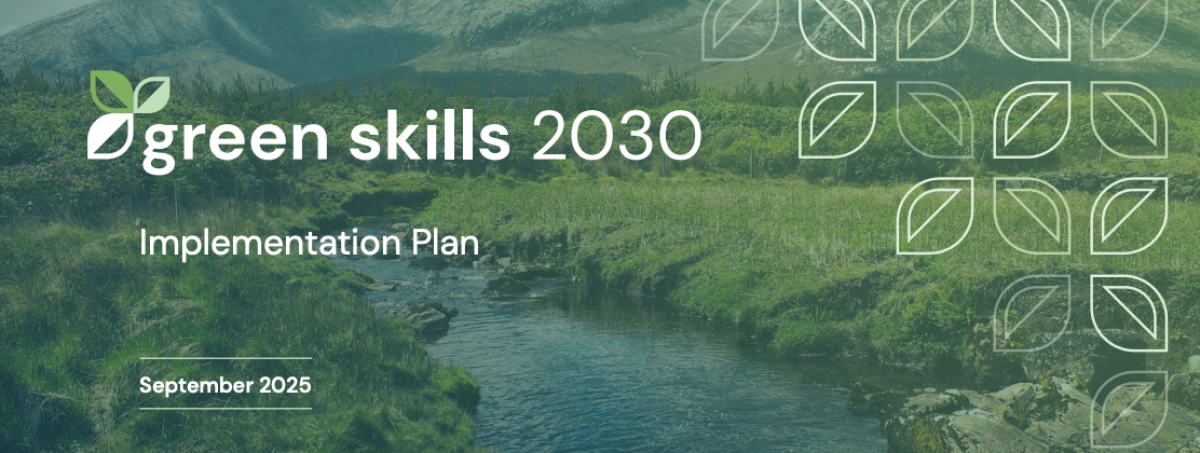
The global green transition is, above all, a workforce challenge. SOLAS, Ireland’s Further Education and Training authority, has addressed this with the Green Skills 2030 Implementation Plan, developed with KPMG, 16 Education and Training Boards and approximately 2,000 employers. The plan is the delivery mechanism for Ireland’s first National FET Strategy for the Green Transition, among the first such strategies operationalised anywhere in the world. For green sector executives, it signals a material shift in how workforce readiness is structured.
The plan contains 24 strategic and 71 sectoral actions, each with defined ownership and measurable targets. Research from the SOLAS Skills and Labour Market Research Unit confirms 75 per cent of jobs in Ireland now require some green skills across construction, engineering, tourism, agriculture and business. Three dimensions stand out: the depth of industry consultation, the responsiveness of the FET model, and the international recognition earned.
The consultation methodology is the plan’s most commercially distinctive feature. SOLAS engaged directly with employers across seven sectors to identify real skills gaps before designing provision, a demand-led approach the OECD examined in December 2025. As Dr Susan Gill, Manager of the Climate Strategy and Skills team, explained: “Without going out to industry, we wouldn’t know what the skill gaps are. Unless employers are telling you what they need, ETBs can’t respond with the development of relevant programmes.”
The Further Education and Training model offers structural advantages that longer academic programmes cannot replicate in a fast-moving regulatory environment. Micro-qualifications and modular training can be updated as technologies evolve, enabling rapid response in zero-emissions building and renewable energy maintenance. Training at the National Construction Campus in Mount Lucas and the Advanced Manufacturing Training Centre in Dundalk demonstrate the system is already adapting to green economy demand.
Ireland’s approach has earned international recognition. Green Skills 2030 has been acknowledged by the OECD and the European Commission as a model of best practice, and SOLAS presented at COP28 in Dubai. The WEF Future of Jobs Report 2025 estimated 59 in every 100 workers will require reskilling by 2030, with green transition roles among the fastest-growing occupations. This strengthens the case for EU funding through the European Social Fund Plus and the Just Transition Fund.
Three actions would accelerate delivery. First, employers should engage their regional ETB to co-design programmes addressing sector-specific gaps, building on the demand-led model. Second, companies should map skills requirements against the 71 sectoral actions, using the KPMG reporting tool to identify available training pathways. Third, the Government should advance the planned 2027–2028 review to an annual cycle, enabling faster iteration as offshore wind, hydrogen and heat pump deployment create rapidly evolving demand.
Ireland’s Green Skills 2030 Implementation Plan marks a substantive advance in aligning a national education system with climate-driven workforce change. Globally, competition for green investment will be decided by labour market readiness. The SOLAS model, demand-led, employer-collaborative and built for rapid iteration, gives Ireland a structural asset in that competition. The task now is ensuring green sector employers become active participants.
(The views expressed by the writer are his/her own and do not necessarily reflect the views or positions of BusinessRiver.)






.png)